When it's a validator's turn to propose a block, they have two options:
The choice seems obvious: relays consistently deliver higher-value blocks. So why would anyone build locally? Privacy, censorship resistance, and solo staker ethos are common reasons. But what's the actual cost?
| Metric | Local Blocks | Relay Delivered | Ratio |
|---|---|---|---|
| Blocks (24h) | 150,075 | 6,732 | 22:1 |
| Average Value | 0.000032 ETH | 0.053 ETH | 1:1666 |
| Total Value | 4.78 ETH | 357.7 ETH | 1:75 |
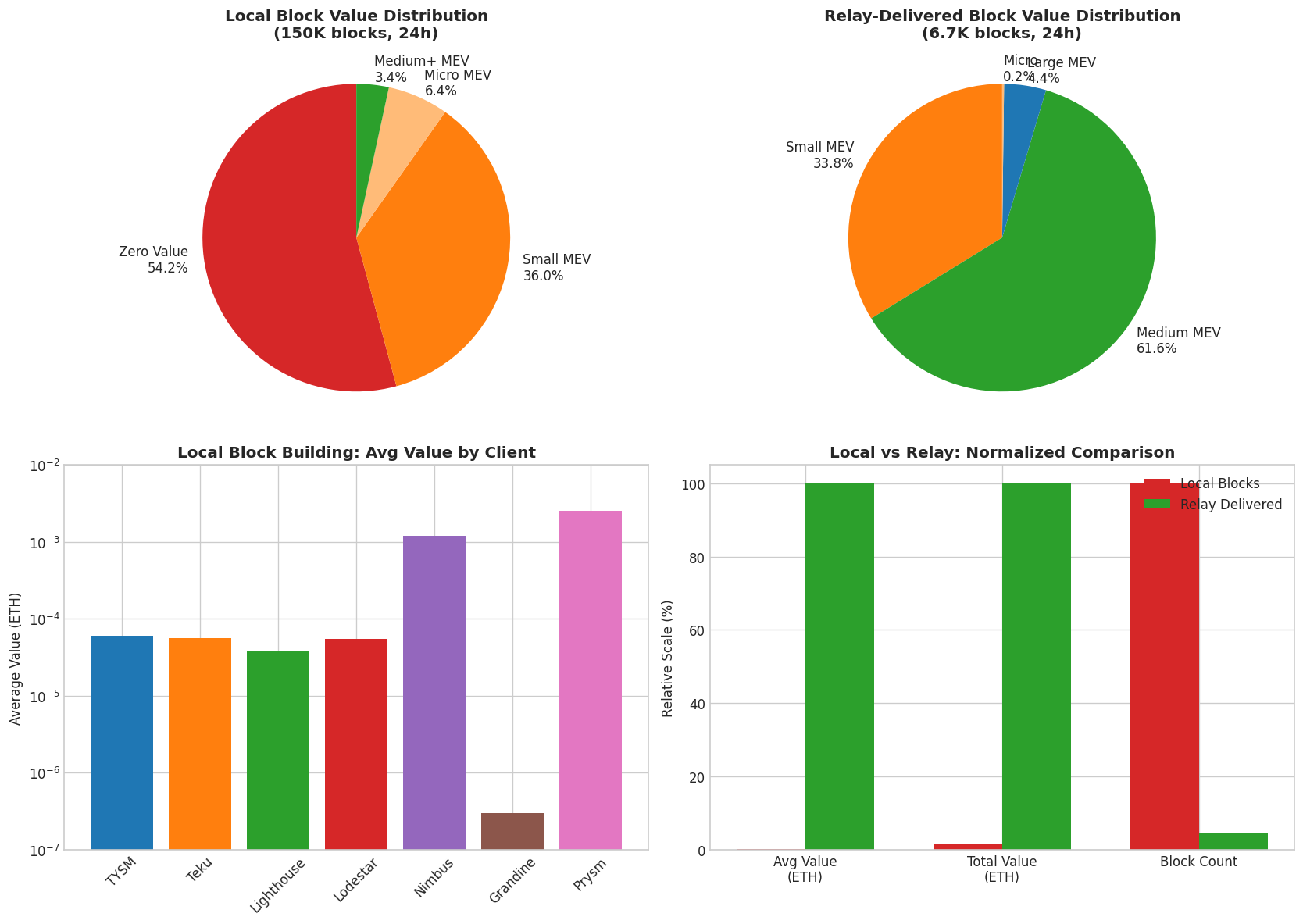
Comprehensive comparison of local block building vs MEV relay strategies across value distribution, client performance, and normalized metrics.
The distribution tells the story:
Not all clients are equal when it comes to local block building. Some appear to have smarter algorithms or attract more sophisticated operators:
| Client | Local Blocks (24h) | Avg Value (ETH) | Performance |
|---|---|---|---|
| Prysm | 7,155 | 0.00253 | 79x better than avg |
| Nimbus | 14,202 | 0.00120 | 38x better than avg |
| Teku | 35,354 | 0.000056 | 1.8x better than avg |
| Lighthouse | 28,724 | 0.000039 | Baseline |
| Lodestar | 14,365 | 0.000055 | 1.4x better than avg |
| TYSM | 43,056 | 0.000060 | 1.9x better than avg |
| Grandine | 7,198 | 0.0000003 | 0.01x (essentially zero) |
Prysm and Nimbus validators who build locally are capturing significantly more value — though still far below relay levels. This could indicate:
If all 150,075 local blocks had used relays and achieved similar value to actual relay blocks, the network would have captured approximately 7,500+ additional ETH in value over 24 hours.
That's roughly 2,700 ETH per year being left on the table by local builders.
The beneficiaries of this inefficiency are clear:
Sources:
mainnet.fct_prepared_block — Local block building data (xatu-cbt)mainnet.fct_block_mev_head — Relay-delivered block values (xatu-cbt)Date range: February 1, 2026 06:00 UTC — February 2, 2026 06:00 UTC (24 hours)
SELECT
  CASE
    WHEN execution_payload_value = 0 THEN 'zero_value'
    WHEN execution_payload_value < 0.001 * 1e18 THEN 'micro_mev'
    WHEN execution_payload_value < 0.01 * 1e18 THEN 'small_mev'
    WHEN execution_payload_value < 0.1 * 1e18 THEN 'medium_mev'
    ELSE 'large_mev'
  END AS value_bucket,
  COUNT() AS block_count,
  COUNT() * 100.0 / SUM(COUNT()) OVER () AS percentage
FROM mainnet.fct_prepared_block FINAL
WHERE slot_start_date_time >= now() - INTERVAL 24 HOUR
GROUP BY value_bucketThis data validates the economic rationale behind MEV relays. The specialization of block building — separating proposers (validators) from builders (searchers) — creates significant value for the network. Validators who forego relays are making a deliberate tradeoff: accepting lower yields for other benefits like privacy or censorship resistance.
The question isn't whether relays are more profitable — they clearly are. The question is whether the non-economic benefits of local building justify the cost. For solo stakers with strong principles, the answer may be yes. For yield-maximizing operators, the data speaks for itself.